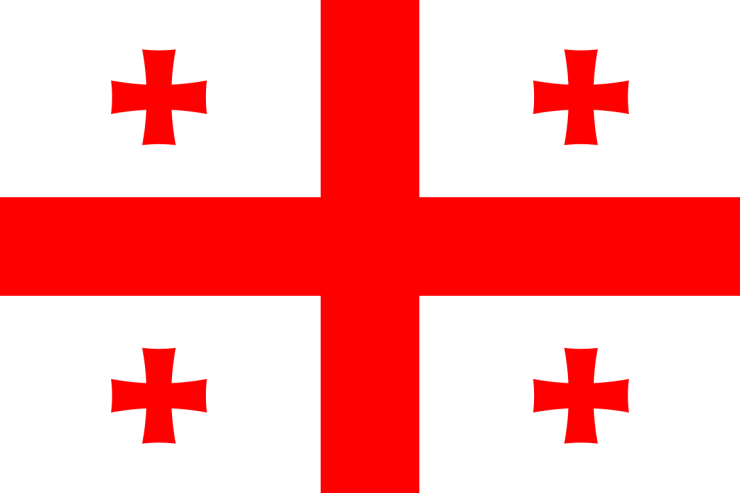
First, some important background. From my pre-trip research, I was surprised and pleased to learn that Georgia is one of the most Christian nations in the world, with 84-88% of her population following the Georgian Orthodox Church. Georgia was the second country in the world (after Armenia) to adopt Christianity as the official state religion in 326 CE. But her Christianity is not in the distant past. The flag, with five red crosses, was adopted in January 2004 after Georgian citizens freed themselves from Soviet control by the, drum roll, Revolution of Roses, or the Rose Revolution, in November, 2003. The peaceful, pro-Western change of power in November 2003 was accomplished by 20 days of widespread protests over disputed parliamentary elections. The protests culminated in the ousting of a president and an end of Soviet leadership in Georgia. The event derives its name from the climactic moment, when demonstrators stormed the Parliament session holding roses. Georgia’s tensions with Russia continue to this day.
June 4, 2017 am. Our first excursion
Part Four
Continued from a Word of Caution
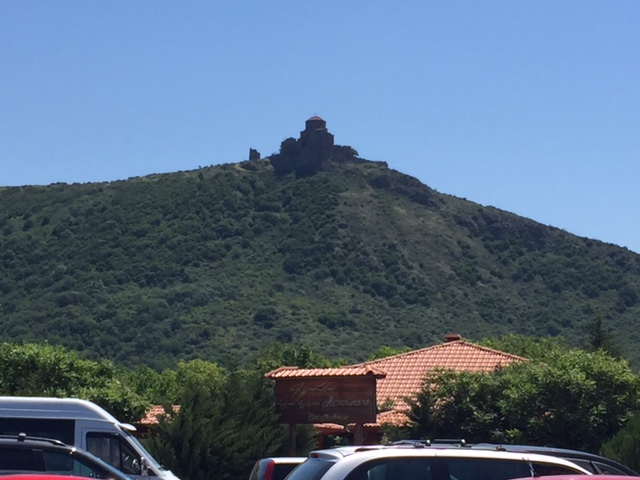
As Lia pointed to the ancient structure perched on the faraway, towering mountain top, she smiled at me, eyebrows raised, hinting that was to be our first stop of the morning.

The Church of the Cross, or Jvari Monastery, in the city of Mtskheta was a half-hour drive from our hotel. I was surprised to see only English as an alternate language on road signs and museum and church markers right under the undecipherable, rounded Georgian alphabet. I saw no Russian Cyrillic anywhere. Perhaps this former Soviet state had purged all remaining vestiges of that seven decade occupation of the Communists. This is a country who, in her long history, has known many occupiers. Today, Georgia is a free republic.

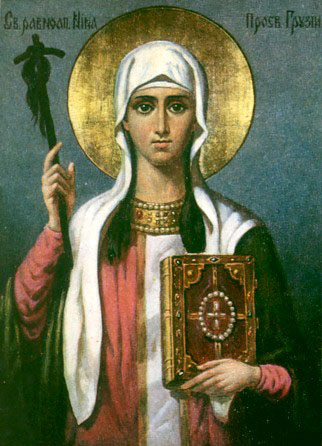
Our guides mentioned Saint Nino often during our week together, with such reverence and familiarity. It was as if they assumed we knew her too. I knew more research was required about the young woman credited to bringing Christianity in the early fourth century to pagan Georgia, then known as the Kingdom of Iberia. We needed to learn a little about the history before we could understand Georgia’s treasures.

Saint Nino (296-338 AD) was born in Cappadocia, a Roman province in present day Turkey. She was a niece of Saint George. When she was twelve, her devout parents left her in the care of a nun for her religious upbringing who taught her about Christ’s life and his suffering. Nino learned how Christ’s Robe, His Seamless Tunic had arrived in Iberia, a pagan nation. (I’ll write more about this when we visit the church where it is believed to have been taken.)
Later, while living in Rome, Nino was convicted to pray to the Virgin Mary, asking to be allowed to travel to Iberia, over 1500 miles away, to venerate the Sacred Tunic removed from Christ before his crucifixion. It was a seamless garment, woven by Mary for her son. Matthew 27:35 modern translations speak of casting lots to divide up Jesus’ garments, but Georgian tradition says it actually means they cast lots to see who received this one revered garment, because it was without seam and most unusual, and very valuable. The garment was sold to a Jew who eventually carried it to the Kingdom of Iberia.
Mary heard Nino’s prayers, and appeared to her in a dream, telling her to go to that land to preach the Gospel of Jesus, and Mary would be her protector. The dream frightened Nino, who questioned if it were a real Visitation. In response, Mary presented her with a cross of grapevines and proclaimed, “Receive this cross as a shield against visible and invisible enemies.”
When Nino awoke, she was holding the cross in her hands. She dampened it with her tears of rejoicing and tied it securely with her own hair.
Before she left Rome, Nino baptized almost forty virgins who consecrated their lives to Christ. The Roman Emperor at that time, Diocletian (284-305), a ruler infamous for persecuting Christians, took a liking to one of them, Rhipsimia, and wanted to marry her. The forty nuns escaped to Armenia. The furious emperor sent his soldiers to follow them, and sent a message to alert King Tiridates (286-344).
King Tiridates intercepted the women, but he, too, was charmed by Rhipsimia’s beauty and resolved to marry her. When she spurned him, the king had her tortured to death, and almost forty other nuns beheaded. Saint Nino, being prepared for a greater task, was spared by hiding among some rose bushes. (I love how God has used roses before!)
Nino finally arrived in Mtskheta alongside a group of pilgrims coming to venerate a pagan god. Nino watched with great sadness the people tremble before a powerless idol. She prayed, “Oh Lord, send down Thy mercy upon this nation . . . that all nations may glorify Thee alone, the One True God, through Thy Son, Jesus Christ.”
Suddenly a violent wind blew and hail fell, smashing the pagan statues, scattering the worshippers.
Saint Nino made her home beneath a bramble bush in the garden of the pagan King Mirian III. The gardener and his wife were childless, but through the prayers of Nino, God granted them a child. The couple rejoiced and declared that Christ was the True God. Wherever she went, those listening converted to the Christian Faith in great numbers.
King Mirian was not pleased with the attention Nino was getting in his village with all the talk of this Jesus. His gardeners claimed Jesus, through this young woman, had cured their childlessness. Then his own wife, Queen Nana fell deathly ill, and Nino used her power to heal her too. Queen Nana also confessed that Jesus was Lord.
While hunting, King Mirian determined to have all the Christians killed. But now his plot would also kill his wife for failing to renounce Jesus. During the hunt, the sun suddenly darkened. All alone, King Mirian was terrified, and he prayed in vain to his pagan gods. Then he turned to Christ and prayed, “God of Nino, illumine this night for me and guide my footsteps, and I will declare Thy Holy Name. I will erect a cross and venerate it and I will construct for Thee a temple. I vow to be obedient to Nino and to the Faith of the Roman people!’
Suddenly the night fell away, and the sun shone again. King Mirian gave thanks to the Creator and surrendered his life to God. He returned home to inform Saint Nino of his transformation, and declared the Kingdom of Iberia to be a Christian nation in 326 AD. He called Saint Nino the Enlightener, and Equal of the Apostles.
I was very interested to learn that modern astronomers have attributed the miracle of King Mirian to a solar eclipse on May 6, 319.
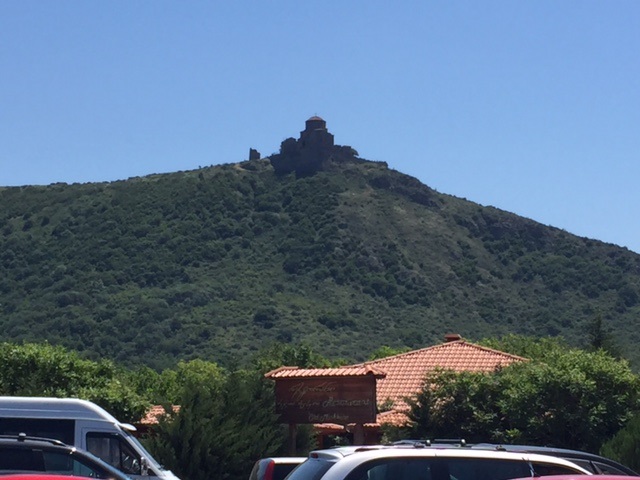
Saint Nino, who is credited to converting the country to Christianity, erected a large wooden cross on the site of a pagan temple. The cross is reported to have been the site of miracles, and therefore drew pilgrimages from all over the Caucasus. A small church was built over the remnants of the wooden cross in c. 545, named the “Small Church of Jvari.” The present monastery, the “Great Church of Jvari” was built between 590 and 605. The octagonal base of the original cross is still preserved in the church.
The importance of the monastery and grounds increased and attracted more
pilgrimages during the late Middle Ages, when a stone wall and gate were added.
During the Soviet era, the church was preserved as a national monument, but no
visitors or congregants were allowed on the site. When Georgia gained
independence, in 1991, the church was restored to active religious use.
The Church of the Cross, or Jvari Monastery, commissioned by the first Christian King of what would later become Georgia was the first of two UNESCO (United Nations Educational, Scientific, and Cultural Organization) protected sites that we visited on our first day in Georgia.
You can see more stunning photos here.
Continue with Part Five.
Don’t miss the exciting and heart breaking stories about finding this lovely family. Begin with Hope for Restoration.
Many Roma and God Stories begin with The Hound of Heaven Winks.
Readers can start at the beginning of our story by reading But the Greatest of These is Love.
Be blessed. Even in the pain, I feel like I have lived something Sacred.
 Consider it all JOY
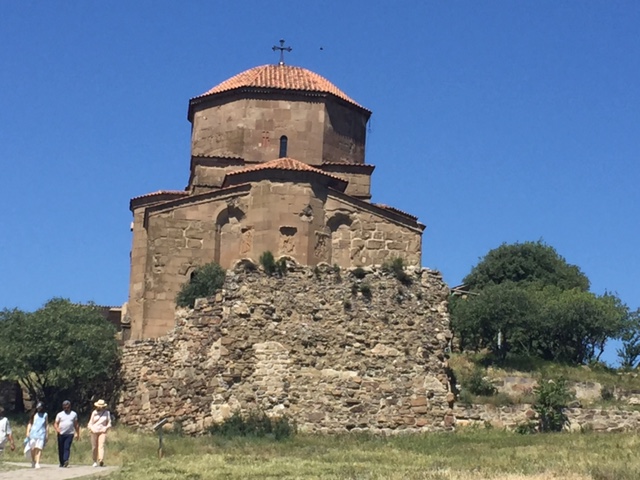
#/media/File:Georgia_Jvari_monastery_IMG_9345_2070.jpg)
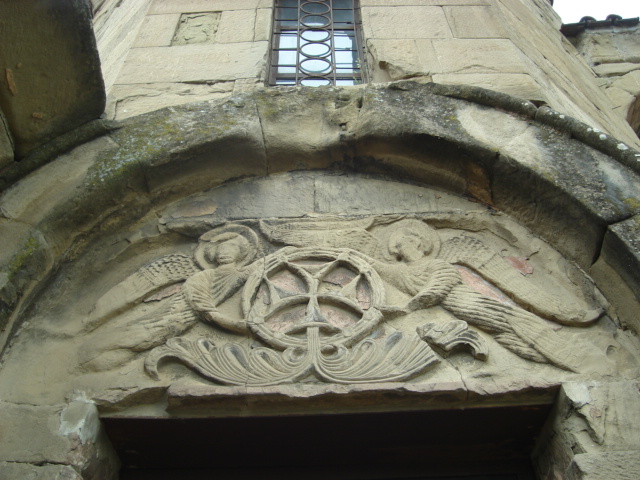
This is interesting to read of the legacy of faith in Georgia.
My brother and sister-in-law visited Tbilisi November 1983, after they, together with 17 other people survived a shipwreck. (Long story). As they shared the miraculous story in the underground church, the people got excited. Later the pastor explained. The same night, September 22, as my father’s gospel ship sank south of Borneo, Indonesia, that church held an all-night prayer watch. First, a 12-year-old boy, Ivan, spoke, saying he saw a while sailing ship full of evangelists in great danger in a storm. Later an elderly woman said the same, adding that the ship had sunk, but the people were in a small lifeboat. “We must pray for them.”
My nephew, Mika,12, was in that lifeboat. He was angry with God for letting the ship sink. He thought no one knows, no one sees them. If they all die, no one will know what happened. They were far from land on the Java Sea.
God showed the situation to two people in Tbilisi – and the church prayed. Mika is now the pastor of the largest Pentecostal church in Helsinki, Finland.
LikeLiked by 1 person
What a fascinating story, Lisa. Thanks for sharing. I know our Father is trying to reach us all the time. In this modern culture, we hardly look for HIM and His extravagant activities in our daily lives. He has opened my eyes by actions to BIG to miss. And I am so grateful! I just got your book in the mail, and hope to start it this weekend, before family comes on Monday and I will be off my books for while. God bless you for sharing your stories, and this one here. Oh how HE LOVES us! Thanks for following along!
LikeLike