He makes us wait. He keeps us on purpose in the dark. He makes us walk when we want to run, sit still when we want to walk, for He has things to do in our souls that we are not interested in.
—Elisabeth Elliot, Secure in the Everlasting Arms
When the tidal wave of Roma’s hormonal teen years rolled over us, I experienced new concerns. His self-confidence sometimes took on an appearance of haughtiness. I saw the temper that had not manifested earlier. Was this just normal teen behavior? Was it a sign of some buried early trauma? I tried not to see a pathology in everything, but at the same time, I did not want to ignore signs that needed attention. Roma had always been assertive; we preferred that word to “bossy,” but he was also kind and respectful. As a teenager, he became mouthy and rebellious to Bruce and me. Away from home, he behaved. My three older children had not been so spirited.

On one occasion when he was in the ninth grade, I picked him up from school, as he requested, so he wouldn’t have to ride the bus. I expected some gratitude. Instead, he was gruff, sassy, and disrespectful. I was not going to allow or reward that behavior. As I drove into the garage, I told him my car was not leaving the house again that day.
“But mom, I have baseball practice,” he was suddenly a little less bold.
“I’m aware. You can still go. You can walk. It’s only a couple of miles.” I was shocked at my calm delivery. This time, I didn’t raise my voice. With teenage Roma, I had discovered that too often I allowed myself to get angry enough to engage with him like another surly teen, to get down on his level. I had resolved not to raise my voice, and this time I kept my cool.
Roma followed me into the house closely, laughing like it had all been a joke. But he had lived with me for seven years at this point. He knew his mom. I could be every bit as stubborn as he.
“Are you kidding?” He asked sincerely, just to make sure. I didn’t make eye contact with him but confirmed I was indeed serious.
“Okay,” my suddenly reasonable boy said. “Could I use your computer to find any shortcuts for my walk?”
“Sure.” I went into the study and logged into our only computer. Roma had no phone, nor a television in his room. Imagine the poor boy’s humiliation in 2009, when all his friends had all the tech toys he coveted. But I was an old-fashioned mom. Roma had to wait until he was 16 to get his own phone.
He emerged from the study excited with a revised plan. He had mapped his route. Actually, there was no “short cut.” But Roma always had to appear in charge, like this had been his idea to walk and not a consequence of bad behavior. It was a pretty direct route. Only one major road in our small town needed to be crossed. There were traffic lights there. By the time he was set to leave, an hour early, it began to drizzle. I felt a twinge of guilt, but it passed quickly. If I changed my mind, Roma would see it as a sign of weakness, and my word would never mean anything again. My “no” had to mean no from the first moment I met Roma. Now that he was a moody teen, it was even more important. Roma left with his equipment in a waterproof bag and a hooded jacket. I told him to be careful, and off he went without complaining.
He came home hours later, dropped off by his coach. He draped his smelly and sweaty arm over my shoulder, and before I could say anything, he said, “Mom, I just want to say I’m sorry for the way I talked to you. I had a nice adventure. I saw neighborhoods I never saw before. Coach said I need to apologize. I know I do.” Only Roma could have felt empowered by his punishment. He had a gift of turning a negative into a positive. He was pumped at his new self-reliance and independence. I was pleased that I had stood my ground, that he did not resent me, and that he had accepted responsibility for his actions.
Flair ups with Roma the teenager were not rare, but usually they could be defused quickly by “the look.” He was a bright boy and could be reasonable.
His high school years brought new challenges. Roma had always been an athlete and hadn’t even seemed to notice girls. Suddenly he was girl-crazy and fancied himself the class clown. And his grades began to plummet. There had never been a doubt that Roma was intellectually bright. But suddenly there was no evidence on paper. I could not coerce him with threats. His charm had always paved a way for him, and he wrongly assumed that his winning ways could navigate any and all roadblocks.
Was this a symptom of early trauma, or male teenage arrogance? I was aware that I might not see signs of problems, issues which could lead to peril for Roma and for our family. My links with adoption communities caused me to ask questions. I knew we needed to at least consult experts.
I found an “adoption trauma” counselor. She had adopted two Russian boys about Roma’s age. Dr. L. spent 20 minutes talking to me alone in our counseling sessions. I told her what an amazing boy Roma was. I told her he was smart and a delight, and he might have Oppositional Defiance Disorder. I had been on the internet doing a little self-diagnosing. She seemed to doubt that in one breath I could call him delightful and then suspect he had ODD.
I added that he had an adult sense of humor, a comment I had first heard from his elementary school principal. He had shared that it was a sign of intelligence. But that description made the therapist cringe. “Children shouldn’t have adult senses of humor. They should have children’s senses of humor. That indicates to me that there might be trauma.”
She hadn’t met Roma yet. That was the least of the indicators for me that Roma had problems. I had never been in a counseling environment before and was more than a little intimidated. I suddenly felt foolish for mentioning my fondness and amusement in his humor.
After my 20-minute session, she had equal time with Roma. Then she spoke with both of us together. She expressed her surprise as we sat close on the sofa, Roma’s arm draped across the back behind me. “You seem to really like each other. So often my clients sit in opposite corners and can’t look at each other.”
“Yeah, my mom’s cool,” Roma affirmed that I wasn’t the enemy.
I flashed my proud smile. “Roma’s a great kid.” I repeated, with total sincerity. “Look at his bright light. He is such a joy. And an aggravation,” I teased as I held his chin between my fingers, so we could admire his captivating smile, which Roma flashed on cue. “I’m worried about him because I know he is smart, and yet he’s got a block right now. We want to deal with any problem, if there is one, now, so we can get on with life. When Roma came to live with us, I treated him like he’d just been born, ignoring that he had almost eight years of life under his little belt. If he has hidden pain, I want to help him to have relief.”
We returned weekly in this manner. On the fourth week, Dr. L. surprised me by saying in my private part of the session, “In my 23 years of adoption counseling, I have never found an adopted kid without trauma. But I don’t see it in Roma. And I think it is because of you. You have loved him well. And it is obvious that someone in his early life gave him the love he needed. Maybe an advocate at the orphanage?” she wondered.
I responded that he had a sister in Russia, ten years older, who had taken care of him. “He talked about her a lot. I have no doubt that she loved him,” I said.
I was stunned, but so pleased that she found no pathologies in Roma. But still, we didn’t get to a solution. Roma was failing in school and we didn’t know how to help him. When Roma joined us in our session, Dr. L. told Roma that she didn’t think she could help him, but if he wanted to continue, she would be glad to see him each week.
Roma said, “Nah, it’s all good. Counseling is expensive, you know. And I’m paying.”
Dr. L. mouth opened in alarm, and she looked quickly from him to me.
I shook my head no. “He’s kidding,” I assured her. It was his adult sense of humor that was hardwired into his personality. It wasn’t there because of trauma. I returned to the observation of Roma’s first principal. His adult sense of humor was a sign of his intelligence.
Part of me had hoped there would be a “diagnosis,” a switch that Dr. L. could flip, so multi-dimensional Roma would fit in a neat, tidy, conformist box, so he would do his homework, succeed academically, and find a path forward. But his grades were poor, if not yet failing. The failing grades would soon come.
What will become of Roma, I often wondered. In his third year of high school, it became clear he would not be ready to graduate on time, even if he passed all his classes. He just wasn’t ready, maturity-wise to finish school; he had no concrete goals for his future. And he couldn’t spend five years in high school, and just languish. I remembered teasing him when he began ninth grade, “Roma, high school–it’ll be the best five years of your life.” That joke suddenly wasn’t funny. Even Roma wasn’t laughing anymore.
He was too proud to repeat grades in his high school, where it would be known by all that he had failed. He couldn’t do five years of high school, especially when he couldn’t play sports that fifth year. So, I began searching for private schools. And then all boys’ schools. And then military academies. I grew up in the south where a lot of our brightest boys left for military academies by the time they were in high school, to “make them men,” with the structure of the military without the dangers. But were military schools filled with delinquents now? Roma was not a behavior problem. I didn’t want to send him off to train to be one.
I suddenly began hearing advertisements on our Washington, D.C. radio station about private schools. Fork Union Military Academy (FUMA) was one I checked out. But it was three hours away. Could we send Roma to a boarding school? I took a few steps in that direction to see if God would open doors, or stop us. I called with some questions.
The guidance office at Fork Union began my phone inquiry by asking, “Now, has your son ever been expelled or suspended from school, because we are not a reform school.”
With that confirmation, I made an appointment to take Roma for an interview for the school year beginning the fall of 2011. No obligations. Just a fact-finding mission.
On a cold and dreary day in late winter, 2011, Roma and I made the three-hour trip into rural middle Virginia. Rural. I was a little disappointed as we got closer to the school that it was out in the middle of nowhere. I knew this would not work for my extremely extroverted boy. I felt he would more likely thrive in a big city. Not that we lived in a big city, but at least we could get to a store or gym or restaurant in five or ten minutes, or walk to baseball practice, if the need ever arose again.
We didn’t talk much on the drive. I daydreamed through radio noise and would occasionally force a conversation. Roma was not typically a quiet child, so I wondered what he was thinking as he looked out his window on a bleak, winter landscape as we neared the campus of all boys.
Roma, wearing tie and dress clothes, offered his hand without my prompting to the officer who greeted us. Some moments I was overwhelmed with pride for this charismatic boy/man I had been gifted. I sat with a book in the lobby, although I couldn’t concentrate to read, while Roma interviewed with the man who would be making a big decision about Roma in an office nearby.
After his private interview, I was invited to join them. The officer said it was his opinion that Roma was exactly what the school looked for in a prospective cadet. First, he would be required to get recommendations from his teachers as part of his entrance evaluation. Depending on how timely he could have that done, he could easily know in several weeks if he could be a new cadet at Fork Union Military Academy for the upcoming fall semester of 2011.
I was struggling to share this gentleman’s enthusiasm. I was confident that Roma wasn’t going to agree to any of this. And I couldn’t blame him. A boarding school military academy three hours from his home, leaving his tight group of friends, his loving family, to go to a place in the middle of nowhere, with no girls. And no cell phones. The dreariness of the day and the somber campus had deflated my hopes.
We drove away from the campus and didn’t speak for several miles.
Roma broke the silence, “Okay Mom,” I could hear his plan materializing. “This is my deal. You don’t have to get involved at all. Just stay out of it. I’ll get my own teacher recommendations.” Everything always had to be on Roma’s terms. But he trusted me to have his best interests always at the center of my heart.
“Okay Roma, go for it.”
Thus began our two-year association with Fork Union Military Academy in the middle of Virginia, and nowhere.
Continue to Chapter Three
 Consider it all JOY
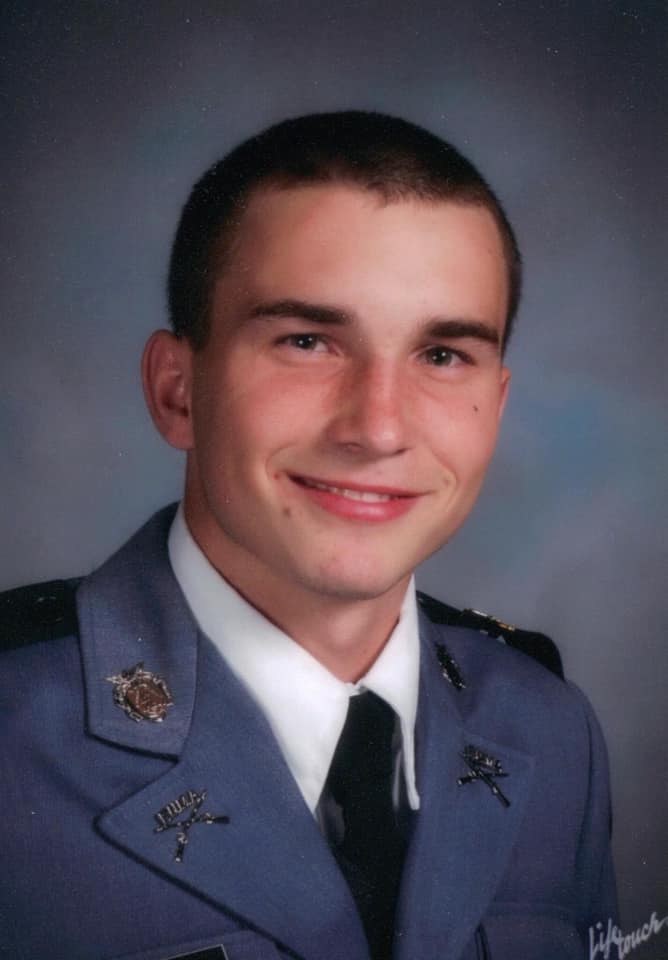
He was such a beautiful soul. I love that you have shared how he spoke to you and the words he said. Clearly he was very intelligent and oh so handsome in that uniform and that smile.
LikeLiked by 1 person
Kim, he was a special gift. We always talked and talked. He told me things that shocked me sometimes, but I’m so grateful he was comfortable to tell me so much. We were so much alike, and yet so different. God made a perfect match when He brought us Roma. So much connection! I can still hear his voice and his words. And his laugh.
I am blessed!
LikeLike
Oh Dear Debbie, God’s leading is so different than the ways that we would choose to go! But I am so blessed that He knew the plans that He had in mind for Roma. From the time he was so young, he impacted so many different people! And when I see that military school picture, you know I just thought so much about your dream of Heaven. What amazing stories will be uncovered when the veil is lifted!
LikeLiked by 1 person
God foreshadowed so much of what was to come. Watching Roma, I could see God at work, and I got to know God better through Roma. Thanks for reading, dear Bettie, and loving Roma and me!
LikeLiked by 1 person
Just coming to read this after publishing the piece on “train up a child”. Oh how I see you honoring God’s call upon Roma’s life, Debbie. You had and still have such an open and listening heart for God’s plans and purposes that turn our own plans and purposes upside down. May God send out your story to encourage other Moms to follow God’s plan and surrender their children into His safe and loving hands.
LikeLiked by 1 person
Thanks Anna. That period of feeling like my life was out of control, I was reminded so frequently by the Holy Spirit that there was always a Helper so close that loves my children more than I do!
LikeLiked by 1 person