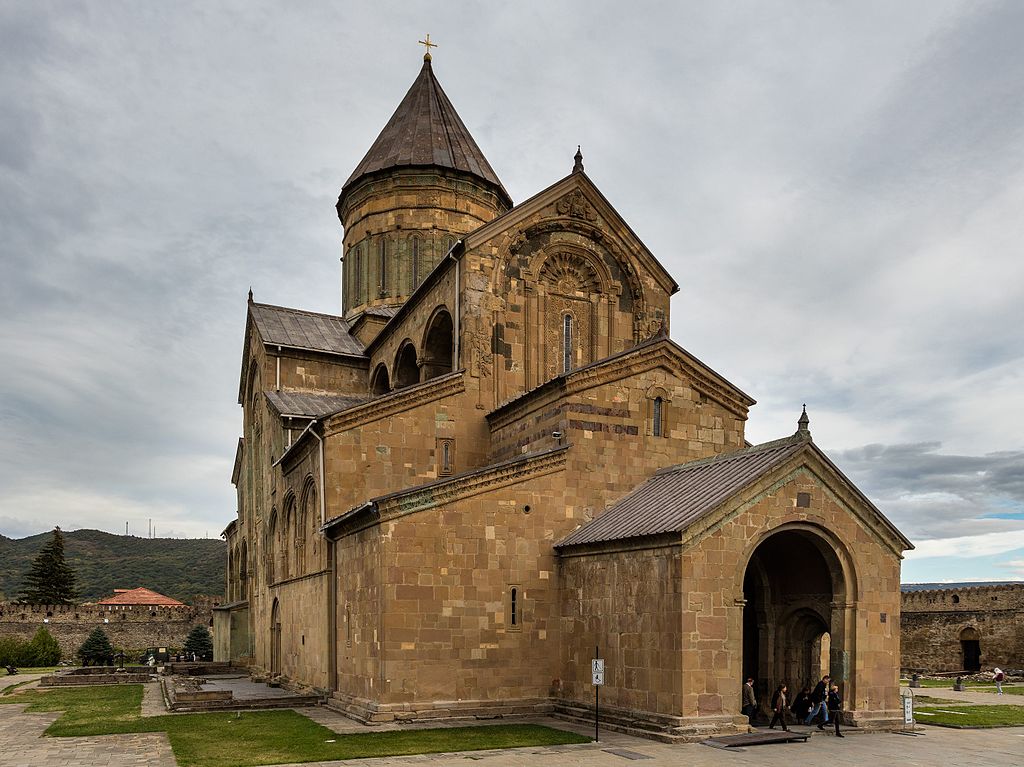
After our morning visit to the Church of the Cross, we drove to the Svetitskhoveli Cathedral, another UNESCO site in Mtskheta, the ancient capital of Georgia. Mtskheta is also known as “the Second Jerusalem.” Some of the oldest Jewish communities in Georgia trace their migration to the 6th century B.C. during the Babylonian captivity when King Nebuchadnezzar conquered Jerusalem in 586 B.C.
Svetitskhoveli was the largest church building in all of Georgia, until the construction of the Holy Trinity Cathedral, built in Tbilisi from 1995-2004 after the fall of Communism. The present day church was completed in 1029, but the original church dates back to the early fourth century and the reign of King Mirian III, the first Christian king of Iberia, converted by Saint Nino.
This Cathedral is best known in Georgia as the burial site of Christ’s Robe. The story goes that a Mtskheta Jew, Elias, was in Jerusalem when Jesus was crucified. He bought the valuable seamless robe from a Roman soldier at Golgotha and brought it back to his native city.
Upon Elias’s return to Georgia with the Sacred Robe, his sister, Sidonia, in her excitement and joy, died tightly clutching the robe. It could not be pried from her firm grasp, and fearing damage to the precious garment, Sidonia was permanently enshrined with the robe in the Svetitskhoveli Cathedral.
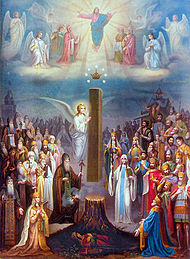
From the tomb of Sidonia and Christ’s Robe grew an enormous cedar tree. Saint Nino came to Georgia three hundred years later, to venerate the Lord’s Robe. She had the tree cut down to build the first church. She had seven columns made for the building. The seventh beam had magical powers, and lifted itself into the air. It returned to earth after St. Nino prayed through the night. Only that seventh column oozed a sap that had healing properties. Many people were cured from all diseases. The site became a destination for pilgrimages beginning in the Middle Ages to the present. Because early pilgrims would cut parts of the wooden column to take with them, a stone enclosure was built encircling the holy column. Archeological testing in recent years confirmed there is a wooden beam in place inside the stone structure built for its protection.
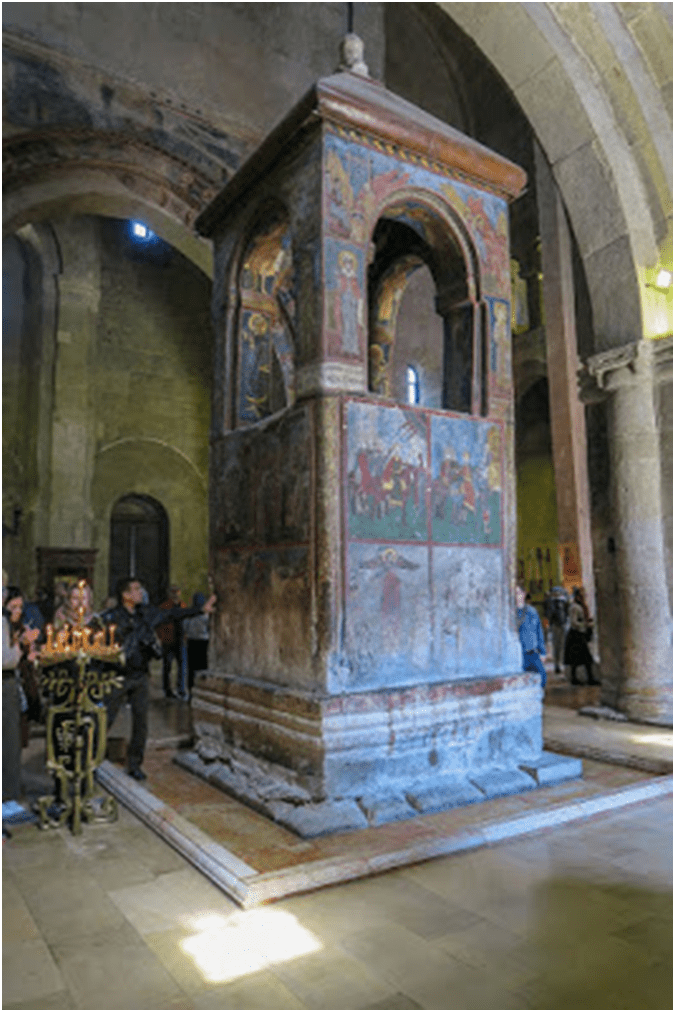
In Georgian, sveti means “pillar,” and tskhoveli means “life-giving” or “living” so the name Svetitskhoveli literally means “Cathedral of the Living Pillar.”
Christ’s Seamless Tunic remained in Georgia until the seventeenth century, when the Persian Shah Abbas I invaded Georgia and stole the Robe. In order to gain favor with Tsar Mikhail Feodorovich, the Shah sent the Robe as a gift to Patriarch Philaret (1619-1633) and to Tsar Mikhail in 1625. The authority of the Robe was attested by Nectarius, Archbishop of Vologda, by Patriarch Theophanes of Jerusalem, and by Joannicius the Greek. Reports also circulated at that time of the miraculous signs being worked through the Holy garment.
The priceless Robe was eventually divided. Two portions of the Robe were taken to Saint Petersburg in 1625, one to the Winter’s Palace, and the second, to Saints Peter and Paul Cathedral. Moscow also houses a portion of the garment at the Cathedral of the Dormition. There are small portions at other ancient temples.
The Russian Orthodox Church commemorates the Placing of the Honorable Robe of the Lord at Moscow on July 10 annually, since it was first placed there on the Sunday of the Cross, during Lent of 1625.
Svetitskhoveli has survived many adversaries over its long history, notably, invasions from Arabs, Persians, and Timor in Indonesia. Many priceless ancient frescoes were destroyed during the Soviet era, by whitewashing. Also, earthquakes have damaged the ancient structure originally constructed in the fourth century, with additions in the eleventh century.
The grounds inside the walls of the complex are a bustling little community. We went on a Sunday and witnessed a baptism celebration spilling from the church while vendors lined the sidewalks selling traditional Georgian wares, such felted toys and shoes, and Churchkhela, which at first glance, I thought were knobby hand-dipped candles They are actually nuts strung together with string and dipped like candles into fruit pulp and dried. Our hosts compared it to “American Snickers.” We dined inside the complex, tasting our first Khinkali (meat dumplings) and Khachapuri (cheese pie). These Georgian staples would become a familiar favorite throughout our week.

After lunch we headed to Uplistsikhe, about an hour’s drive from Mtskheta. Identified by archaeologists as one of the oldest urban settlements in Georgia, Uplistsikhe literally means “the Lord’s Fortress. ” It dates back to the early Iron Age (1200- 600 B.C.), and older by some archaeological estimates, to the Bronze Age (3000- 2400 B.C.). To think we Americans consider houses built in the 1800’s to be old. Some later structures were added during the Middle Ages, or Medieval period, a thousand-year period from 500 A.D. to 1500 A.D, which began with the fall of the Roman Empire until the rise of the Ottoman Empire.

Uplistsikhe was an important religious, political, and cultural center. Situated above the Mtkvari River, the city stood directly on the path of the old Silk Road and was a strategic and commercial center. The Silk Road was used regularly from 130 B.C. when trade from China was officially opened to the west, to 1453 A.D. when the Ottoman Empire boycotted trade with the west and closed the routes.
The town enjoyed its heyday as early as the 9th-11th century when its population neared 20,000.

When Christianity came to Georgia in the fourth century A.D. in Mtskheta, and later Tbilisi, Uplistsikhe declined in importance. However, Uplistsikhe remerged as a principle Georgian stronghold during the Muslim conquest of Tbilisi in the eighth and ninth centuries. The Mongols raids in the 13th century marked the ultimate collapse of the town, and it was virtually abandoned except for an occasional temporary shelter in times of foreign invasions. The Mongols invaded Georgia in 1220 and again in 1231. At that time the Kingdom of Iberia included present day Georgia, Armenia, and much of the Caucus countries, including all or parts of Azerbaijan, Iran, Russia, and Turkey.
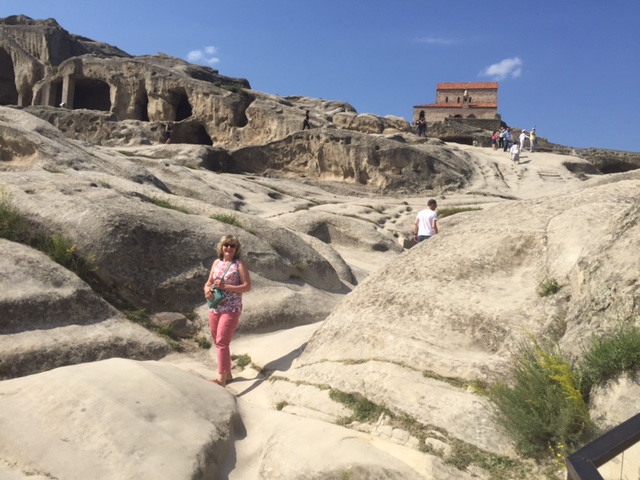
Georgia fell under the domination of the Ottoman Empire in the 15th century. During the 18th and 19th century, it transitioned from being a mainly Iranian centered country to a Russian annexation.
Several of the most vulnerable areas were completely destroyed by an earthquake in 1920. The stability of the sheer rock monument remains tenuous.
The living quarters and areas for communal purposes occupy a cliff of almost 20 acres. They are connected by steps carved into the stone. The majority of the caves are devoid of decoration. The large central meeting hall has coffered tunnel-vaulted ceiling and a palace complex.

The basilica is from the 6th century, and a three-church basilica built out of brick in the 9th and 10th centuries. Later churches were added during the medieval period.
In ancient times, there were up to 700 caves, but today, only 150 have endured.
After leaving Uplistsikhe, we stopped briefly at another church where we drank “holy water” from a spring through a hose in a stone wall. I would never have done that at home, fearing I might get sick. But on this trip, I felt invincible. We were still on day one. It was hard to believe we had gotten off the plane in Tbilisi earlier this same day, just after midnight. And we were still going strong.
The best part of our day was yet to come.
Continue with Chapter 41
 Consider it all JOY
Such a fascinating history, but for some reason this bit keeps coming back to me – especially the whitewashing: “Many priceless ancient frescoes were destroyed during the Soviet era, by whitewashing.”
Jesus describes the Pharisees as whitewashed tombs. And today in 1 John 2:15-16, it struck me that “world” literally means “treating the face as a whole”. It (kósmos=world) is actually the root word our English word “cosmetic” comes from. So world in fact more has to do with this outward pretension. Interestingly in the last part of that verse, the hypocrisy/boastful pride mentioned literally means:
HELPS Word-studies
212 alazoneía (a feminine noun derived from alē, “wandering, roaming”) – properly, a vagabond (“quack”), making empty boasts about having “cures” to rid people of all their ills (even by producing “wonders,” etc.).
LikeLiked by 1 person
Anna, you teach me new things all the time. When I saw those whitewashed walls I wondered what beauty was lost to world by that deliberate act to destroy.
LikeLiked by 1 person
But like you said with Jesus nothing and no one is ever “lost”. He’s lifting away the whitewashing to reveal His heart – in the dying. So out of that tomb (religiousity) is coming new life (Jesus: His love and union in the Spirit) 😊.
LikeLiked by 1 person
So true. We see with our eyes. And He sees through to our heart.
LikeLiked by 1 person
His heart He’s hidden in us:
He has made everything appropriate in its time. He has also set eternity in [our human] heart, without the possibility that mankind will find out the work which God has done from the beginning even to the end.
LikeLiked by 1 person
His heart He’s was hidden in us— we are made in His Image.
That realization should humble us to our cores, and spark total surrender and allegiance to Him alone. Total surrender and obedience is what He wants. We should want it too, for He writes the BEST stories for our lives.
LikeLike
Yes: and that means being His servant in uncovering His heart- by His Spirit – in others, as we obey Him and His nudgings (as you did in adopting Roma and going to Georgia). I firmly believe He’s actually waiting on us to awaken others in His Spirit. He’s already in them – His seed – waiting for the uncovering. Just look at all the generational Promises He has made: now it’s our job to claim those Promises the world over and walk into them.
LikeLiked by 1 person
Madeleine L’Engle wrote, “We draw people to Christ not by loudly discrediting what they believe, by telling them how wrong they are and how right we are, but by showing them a light that is so lovely that they want with all their hearts to know the source of it.”
That left an impression on me, and challenged me to simply reflect Jesus.
LikeLike
That is SO true! So beautifully true!!!
And really it’s Christ revealing or showing Himself through us, isn’t it? All we are doing is dying to ourselves daily – and even that is His work in us.
LikeLike
This verse just came up in my reading. Very timely.
“And those who have insight will shine like the glow of the expanse of heaven, and those who lead the many to righteousness like the stars forever and ever.” (Daniel 12:3)
Thank God He gave us faith and insight.
LikeLike
Amen and may He increase that faith and insight more and more and more and more, daily and moment by moment!!!
That verse has been so precious to me. It makes me think of what I shared with my Velvet Ashes Connection Group a few weeks ago. I will copy-paste it here: my husband told me this past week that stars, unlike the sun’s rays on earth, do not have an equal distribution of colors. Red is more present in the stars (the blood of Christ 😊). These stars are continually dying suns – but because there is a delay in their light reaching us here on earth – by the time we see the stars in the heavens, they have already died (but their light still shines brightly 😊). Isn’t that amazing. The heavens declare the glory of God.
It’s in the dying, light shines!!! It’s in our repentance, Jesus is lifted high!!
LikeLiked by 1 person
Oh Anna, I LOVE that. Thanks for sharing!
LikeLike
Oh this just makes my heart sing, Debbie! You see, I’ve been “listening” to someone else’s (Jewish) family story of persecution and what I saw is that the enemy tried to steal their faith but what has been happening is that the old has been dying for the new heart to be uncovered in them piece by piece. I see Jesus awakening hearts and it’s so beautiful. And I think that’s what is happening in Georgia. Interesting for me also, as the au pair before me (for my German host family) came from Georgia too.
LikeLiked by 1 person
Anna, that gives me chills!
This verse comes up everywhere lately. Isaiah 43:19
See, I am doing a new thing! Now it springs up; do you not perceive it? I am making a way in the wilderness and streams in the wasteland.
It’s such a blessing to witness and recognize we are witnessing it.
LikeLiked by 1 person
By that I mean that the enemy took away the established church with all its vestages (and trappings) but that has only been birthing the new – personal relationships with Jesus and a weaving the world over (also through Roma’s Dad’s communion with Jesus in prison).
LikeLiked by 1 person
When I get to that part of the story, of Igor’s drawing in prison. Oh how the tears flowed. It’s coming up soon.
LikeLiked by 1 person
That’s the part I was thinking of 😉😍. And it fits with what I awoke to this morning. The realization that that new wine is repentance flowing and new life being birthed there….on his knees in prison – the old is gone, the new is here! Hallelujah! The stone is rolled away!
LikeLiked by 1 person
Amen!
LikeLiked by 1 person
BTW do you know what started playing as we were chatting about Igor? This:
And it had me weeping. And you have no idea how much I have been weeping tonight listening to my big girl share about her classmate (a foster kid) and all the pain and trauma she’s been through. I told her more about my little brother and the impact of trauma upon him. And I sat balling my eyes out praying for that little girl and her classmates asking God to continue to reveal His heart of love and compassion to her through her classmates who are boldly speaking the truth to her as she goes into fighting mode, but also extending grace upon grace and loving her through it all (with ups and downs). I am loving what Jesus is doing in my girl’s heart.
LikeLiked by 1 person
Oh the tears. I love that song, and the humility it brings. We are all so rounded in snd by this world. Hid intends to restore and redeem it all. Thanks, Anna! For this reminder! Praying for your sweet girl’s heart!
LikeLike